ARPI and DOAC : A Practical Guide and Summary
DOACs & Androgen Receptor Pathway Inhibitors: Navigating Drug Interactions in Prostate Cancer
Despite potent pharmacokinetic induction potential from enzalutamide and apalutamide, landmark 2026 population data offer reassurance — while darolutamide emerges as the preferred ARPI when anticoagulation is required
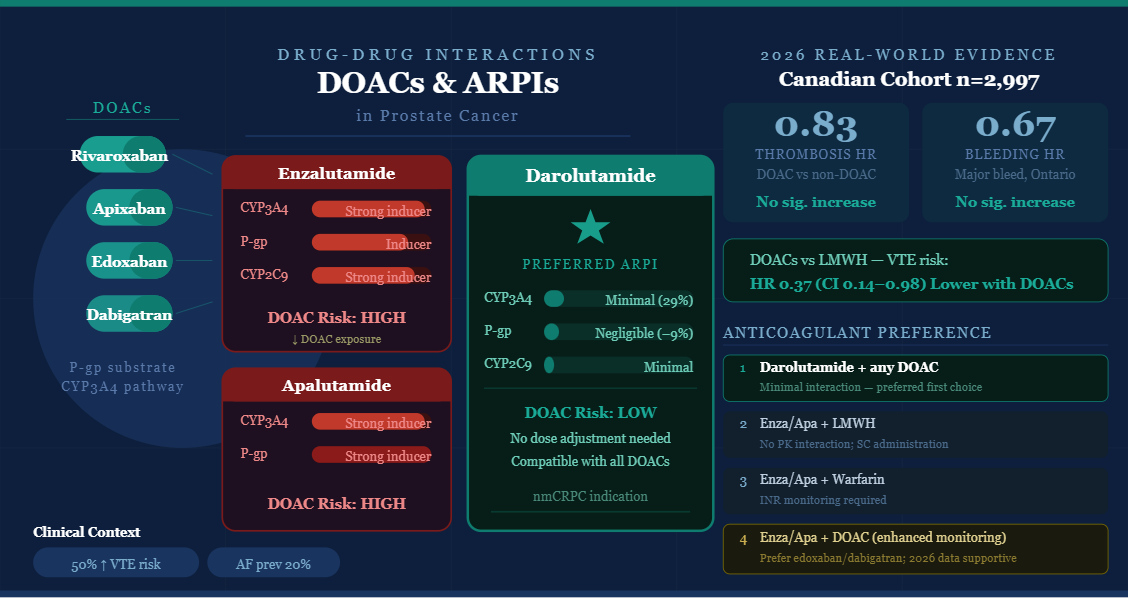
Darolutamide = preferred ARPI with DOACs
No increased thrombosis or bleeding in real-world data
Enzalutamide & apalutamide: strong CYP3A4/P-gp inducers
Edoxaban or dabigatran preferred if DOAC unavoidable with high-risk ARPIs
Prostate cancer predominantly affects elderly men carrying multiple comorbidities and a substantial burden of polypharmacy. Two therapeutic imperatives now frequently converge in these patients: the need for androgen receptor pathway inhibitors (ARPIs) — apalutamide, darolutamide, and enzalutamide — as standard of care for castration-resistant disease, and the need for anticoagulation driven by dramatically elevated rates of venous thromboembolism and atrial fibrillation in this population.
Swedish registry data demonstrate that men with prostate cancer face a 50% increased risk of VTE in the five years following diagnosis, with crude incidence rates of 6.54 per 1,000 person-years. Simultaneously, the prevalence of atrial fibrillation in prostate cancer patients has risen from 14% in 2008 to over 20% in 2017. The result is a growing clinical population in whom ARPI therapy and direct oral anticoagulants (DOACs) must coexist.
Yet this coexistence is pharmacokinetically fraught. ARPIs differ dramatically in their effects on the enzymes and transporters that govern DOAC clearance — and understanding this heterogeneity is now central to safe prescribing.
The Pharmacokinetic Landscape
How DOACs are cleared
All four approved DOACs — rivaroxaban, apixaban, edoxaban, and dabigatran — are substrates of P-glycoprotein (P-gp), an efflux transporter that modulates intestinal absorption. Rivaroxaban and apixaban additionally undergo meaningful CYP3A4 hepatic metabolism (up to 18% and 32%, respectively), while edoxaban and dabigatran are largely CYP3A4-independent. Dabigatran carries the heaviest renal burden at 80% urinary elimination, making it particularly sensitive to renal function changes.
| DOAC | CYP3A4 Metabolism | P-gp Substrate | Renal Elimination |
|---|---|---|---|
| Rivaroxaban | 18% | Yes | 33% |
| Apixaban | <32% | Yes | 27% |
| Edoxaban | Minimal | Yes | 50% |
| Dabigatran | None | Yes | 80% |
Table 1: Metabolic pathways of direct oral anticoagulants. P-gp induction reduces plasma concentrations and may increase thrombotic risk; CYP3A4 induction amplifies this effect for rivaroxaban and apixaban.
How ARPIs disrupt this clearance
The three ARPIs occupy very different positions on the drug interaction spectrum. Enzalutamide is a strong CYP3A4 and CYP2C9 inducer with moderate CYP2C19 induction, and while it and its active metabolite can inhibit P-gp and BCRP in vitro, the net clinical effect is predominantly induction — reducing DOAC exposure substantially. Apalutamide shares a very similar profile: strong CYP3A4 induction and strong P-gp induction, meaning all four DOACs are affected.
“Darolutamide’s structural uniqueness as an androgen receptor antagonist translates into a fundamentally different interaction profile — minimal CYP enzyme effects and no clinically meaningful P-gp induction.”
Zurth et al., Clinical Pharmacokinetics, 2019
Darolutamide stands apart. Clinical studies show it reduces midazolam AUC by only 29% — below the threshold for clinical significance as a CYP3A4 inducer — and reduces dabigatran AUC by a mere 9%, confirming negligible P-gp effect. Its profile as a strong BCRP inhibitor (increasing rosuvastatin exposure 5.2-fold) is relevant for statin co-prescription, but does not affect DOACs meaningfully.
| ARPI | CYP3A4 Effect | P-gp Effect | DOAC Interaction Risk |
|---|---|---|---|
| Enzalutamide | Strong inducer | Inducer | High |
| Apalutamide | Strong inducer | Strong inducer | High |
| Darolutamide | Minimal | Minimal | Low |
Table 2: Comparative drug-drug interaction potential of ARPIs with DOACs.
What the Real-World Evidence Shows
The theoretical pharmacokinetic concerns are real and well-characterised. What remained uncertain until 2026 was whether these laboratory-level interactions translated into clinically meaningful harm — specifically, whether reduced DOAC exposure from CYP3A4 and P-gp induction would lead to more thromboembolic events.
The Canadian multi-provincial study
A landmark retrospective population-based analysis of 2,997 Canadian adults with advanced prostate cancer — 2,107 from Ontario, 890 from Alberta — receiving anticoagulants and either enzalutamide or apalutamide between 2012 and 2023 provides the most important contemporary data. The headline finding: no evidence of increased thrombotic or bleeding risk with DOAC use.
Key Findings — Canadian Population Study (2026)
Thrombosis: Pooled HR for all thrombosis (DOAC vs non-DOAC): 0.83 (95% CI 0.36–1.93). Ontario arterial thrombosis HR 0.95 (95% CI 0.42–2.13); VTE HR 0.49 (95% CI 0.23–1.04). No statistically significant increase in any thrombotic outcome.
Bleeding: No increased major bleeding. Ontario: Major bleeding HR 0.67 (95% CI 0.29–1.55). Alberta: HR 0.50 (95% CI 0.11–2.19).
vs LMWH: DOACs showed lower VTE risk than LMWH (HR 0.37, 95% CI 0.14–0.98 — statistically significant), with similar arterial thrombosis and bleeding rates.
The interpretation is nuanced. The absence of increased thrombosis with DOAC use in enzalutamide- and apalutamide-treated patients may reflect that the magnitude of pharmacokinetic interaction is insufficient to meaningfully compromise anticoagulant efficacy at standard doses; that renal elimination pathways compensate for reduced hepatic/intestinal clearance; or that clinical monitoring and dose adjustments in practice effectively mitigated the interaction. What these data do not do is eliminate the theoretical concern — they provide reassurance, not absolution.
Expert consensus (2024 multidisciplinary panel)
A multidisciplinary panel reviewing ARAT-antithrombotic drug-drug interactions identified 11 drug pairs warranting avoidance and 8 requiring therapy modification or enhanced monitoring. Crucially, the panel acknowledged that the literature on actual clinical consequences remains limited — and these 2026 population data postdate and partially address that limitation.
Clinical Management: A Practical Framework
Choosing the ARPI
When a patient requires anticoagulation and ARPI selection has not yet been made, darolutamide — where oncologically appropriate (nmCRPC indication) — should be the default choice. Its minimal interaction profile renders DOAC co-administration straightforward, with no dose adjustment typically necessary.
When enzalutamide or apalutamide is required
Where enzalutamide or apalutamide is oncologically necessary, anticoagulant selection follows a hierarchy:
LMWH — no pharmacokinetic interaction
Low-molecular-weight heparin is not subject to CYP3A4 or P-gp modulation. Subcutaneous administration and injection-site burden are the key drawbacks for long-term use in this population.
Warfarin — unaffected anticoagulant mechanism
Vitamin K antagonism is not impaired by CYP3A4 induction in the same way as DOAC metabolism. INR monitoring is required and may need to be more frequent during ARPI initiation and dose changes.
DOAC with enhanced monitoring (supported by 2026 data)
- Prefer edoxaban or dabigatran — less CYP3A4-dependent than rivaroxaban or apixaban
- Baseline thrombotic and bleeding risk assessment
- Clinical monitoring at 1 month, 3 months, then quarterly
- Patient education on recognition of thrombosis and bleeding
- Renal function monitoring (particularly for dabigatran: CrCl <30 mL/min contraindicated)
Special Populations and Considerations
Renal impairment
Dabigatran (80% renal elimination) and edoxaban (50%) are most sensitive to CKD. In patients with CrCl 30–50 mL/min receiving these agents alongside a CYP/P-gp-inducing ARPI, the net pharmacokinetic effect is uncertain — induction reduces absorption-phase exposure, while reduced renal clearance may partially compensate. Close monitoring is warranted. Most DOACs are contraindicated below CrCl 30 mL/min.
Cardiovascular comorbidity
Cardiovascular disease accounts for 47% of non-cancer deaths in prostate cancer patients. With atrial fibrillation prevalence exceeding 20% in contemporary prostate cancer cohorts, the competing risks of thromboembolism and bleeding must be carefully weighed against the oncologic imperative. Neither anticoagulation nor ARPI therapy can be routinely deferred; the question is always which combination optimises the risk-benefit ratio for the individual patient.
High thrombotic risk: consider darolutamide or non-DOAC anticoagulant
Men with metastatic or high-grade prostate cancer, recent diagnosis (<6 months), or active treatment demonstrate the highest VTE risk. In these populations, ensuring adequate anticoagulation is paramount. Favour darolutamide-DOAC combinations or LMWH over enzalutamide/apalutamide-DOAC combinations where oncologically feasible.
Monitoring Protocol
Full symptom review
CBC, CrCl, LFTs
Thrombotic symptoms
Adherence check
CBC, CrCl if CKD
Thrombotic symptoms
Adherence check
CBC, CrCl
Adherence
CBC annually
CrCl if indicated
Consider anticoagulant switch
Recheck renal function
Bleeding recognition
OTC drug avoidance
All-provider disclosure
Future Directions
Despite the reassurance offered by 2026 population data, important knowledge gaps remain. Dose-response relationships between DOAC type, dose, and outcomes in ARPI-treated patients have not been characterised prospectively. Direct pharmacokinetic measurement of DOAC levels in patients receiving concurrent ARPIs — particularly enzalutamide and apalutamide — would help quantify the magnitude of in-vivo interaction. Head-to-head comparison of thrombotic and bleeding outcomes with darolutamide versus enzalutamide/apalutamide in anticoagulated patients is needed. And pharmacogenomic variation in CYP3A4, CYP3A5, and ABCB1 (P-gp) may ultimately identify patients at highest risk from these interactions.
Conclusion
Drug-drug interactions between DOACs and novel ARPIs represent a clinically important consideration in contemporary prostate cancer management. While enzalutamide and apalutamide are potent CYP3A4 and P-gp inducers with theoretical potential to compromise DOAC exposure, the first large-scale population-based data confirm that concurrent use does not significantly increase thrombotic or bleeding risks in clinical practice. Darolutamide remains the preferred ARPI when anticoagulation is required. Where enzalutamide or apalutamide is oncologically necessary, the choice between LMWH, warfarin, and DOAC with enhanced monitoring should be individualised, with multidisciplinary input from oncology, cardiology, haematology, and pharmacy.
Selected References
- Population-based study: Risks of thrombosis and haemorrhage with concurrent DOACs and enzalutamide/apalutamide in advanced prostate cancer. Ontario and Alberta cohorts, 2026. PMC12968589
- The Cardiology Advisor (2026). Prostate cancer drugs do not interact with DOACs to increase bleeding risk. Link
- Siddiqui BA et al. (2026). Navigating drug-drug interactions with apalutamide. Prostate Cancer and Prostatic Diseases. Link
- Zurth C et al. (2019). Drug-drug interaction potential of darolutamide. Clinical Pharmacokinetics, 58:1567–1579. PMC6828636
- Hellgren R et al. (2022). VTE risk in men with prostate cancer. BMJ Open, 12(5). PMC9150160
- Leblanc K et al. (2024). Drug interactions between ARAT therapies and antithrombotic agents. Current Oncology, 31(10). PMC11475820
- Graff JN & Beer TM (2022). Apalutamide, darolutamide and enzalutamide for nmCRPC. Cancers, 14(7). PMC8997634