Amiodarone and Radiotherapy : Practical Guide
Amiodarone & Radiotherapy:
Risk Mitigation Across Sites
A practical, site-by-site guide for radiation oncologists, cardiologists, and MDT teams managing patients on amiodarone who require radiotherapy — from thoracic EBRT to radioiodine therapy.
Why this interaction matters
Amiodarone is one of the most commonly prescribed antiarrhythmic agents, used in atrial fibrillation, ventricular tachycardia, and a range of other rhythm disorders. Its prolonged tissue half-life — often measured in months — means patients undergoing radiotherapy may carry significant amiodarone burden even after formal cessation. The compound’s affinity for iodine and its well-documented pulmonary toxicity profile create a unique and clinically important interaction with ionising radiation.
Amiodarone pulmonary toxicity (APT) is estimated to affect 2–17% of patients on long-term therapy, and its radiological and clinical features — bilateral infiltrates, ground-glass opacification, and progressive dyspnoea — overlap substantially with radiation pneumonitis (RP). This diagnostic ambiguity represents one of the most immediately dangerous aspects of the amiodarone–radiotherapy interaction, since the two conditions require different treatments and delayed steroid therapy for combined APT/RP worsens outcomes.
“The expected interaction manifests not only pharmacokinetically, but at the tissue level — amiodarone may act as a radiosensitiser for both lung parenchyma and skin, creating toxicity disproportionate to the radiation dose delivered.”
Georgiou et al., 2019 · Wilkinson et al., 2001
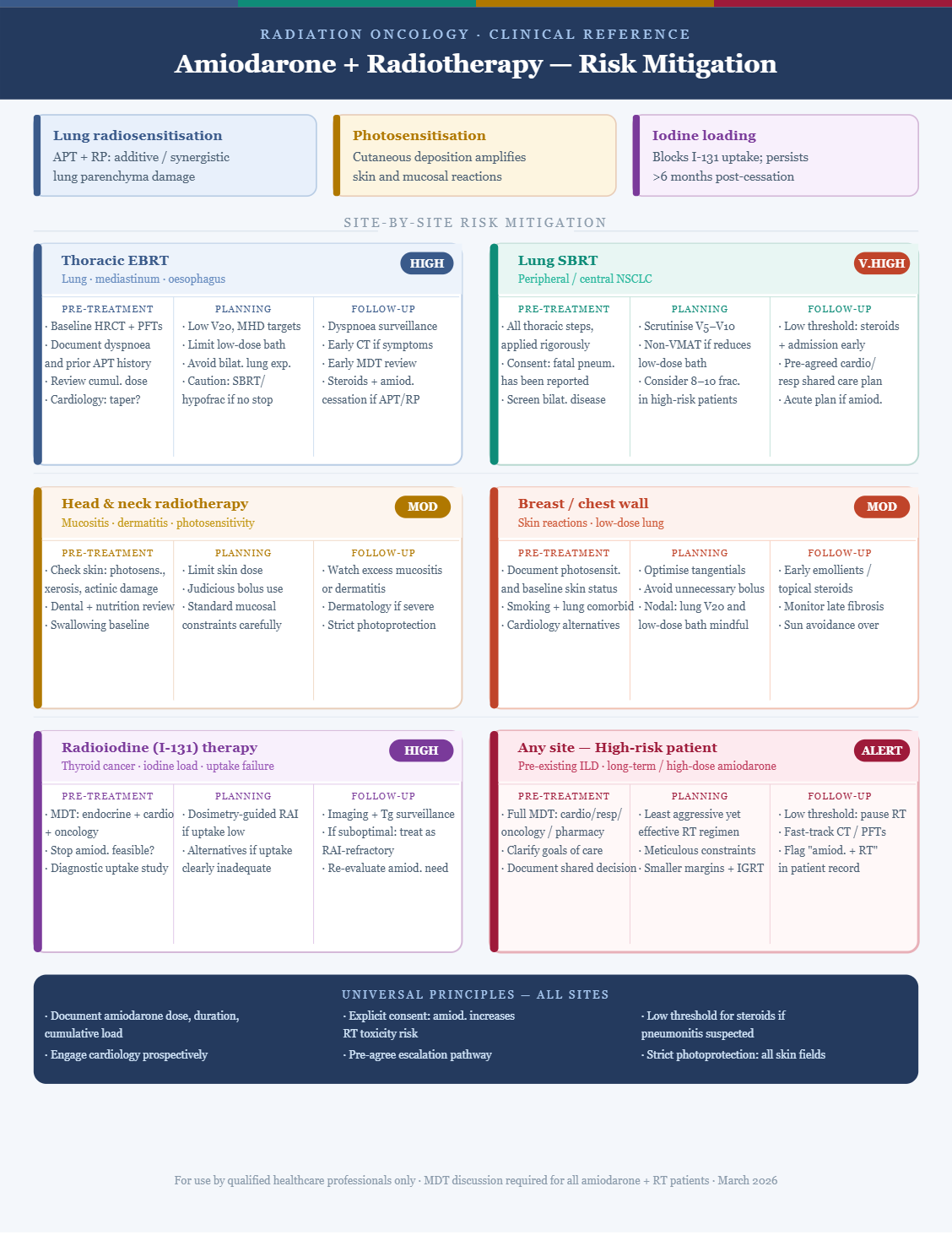
Beyond the lung, amiodarone’s photosensitising properties may exaggerate dermatitis and mucositis in head and neck and breast radiotherapy settings. For thyroid cancer patients, the drug’s high iodine content directly antagonises radioiodine (I-131) uptake, potentially rendering RAI therapy ineffective. Each scenario demands site-specific planning, monitoring, and multidisciplinary prospective management.
Risk mitigation strategies
|
✓ Document amiodarone exposure: dose, duration, cumulative load ✓ Baseline HRCT before thoracic/lung RT in all but lowest-risk ✓ Explicit consent that amiodarone increases RT toxicity risk ✓ Engage cardiology prospectively — not reactively |
✓ Agree shared care plan and emergency escalation pathway in advance ✓ Flag “amiodarone + RT” prominently in the patient record ✓ Low threshold for systemic steroids if pneumonitis suspected ✓ Advise strict photoprotection for all skin-exposed RT fields |
APT + RP create additive/synergistic damage to lung parenchyma. Diagnostic overlap makes early attribution difficult.
Cutaneous amiodarone deposition amplifies skin and mucosal reactions. Tissue half-life can exceed 6–12 months after stopping.
Blocks I-131 uptake in thyroid tissue; may persist >6 months post-cessation. Dosimetric uptake study essential before RAI.
APT and radiation pneumonitis share overlapping clinical and radiological features. Misattribution causes delayed steroid therapy — which worsens combined toxicity. Low threshold for early CT and MDT review is essential.
|
|